DrumUnveil · · · · · · ·
$49 launch price · $69 later · one-time DOWNLOAD — TRY FREE

KUUSOUTOSHI AUDIO —
VST®3 · AU · Standalone

DrumUnveil

Take the loop apart.

Drop in a stereo drum loop and it comes back split into six — kick, snare, toms, hi-hat, ride, crash — with every hit turned into a MIDI note. The separated audio and the MIDI both drag straight into your DAW.

No more programming it back in by hand.

DOWNLOAD — TRY FREE

$49 launch price — $69 once the launch period ends · one-time

Try it indefinitely with your own loops and export kick and snare MIDI before you buy.

VST3 · AU · Standalone — Windows · macOS

SCROLL
VST3 · AU · STANDALONE
WINDOWS
MACOS
FULLY LOCAL — NOTHING UPLOADED

Six parts and the MIDI.

Splitting a drum mix into six is not new. Getting the separated audio and a MIDI part for every lane, without uploading anything, is where the prices start to differ.

Try it for as long as you like
DrumUnveilEvery feature runs across all six lanes, with no time limit — and you can export kick and snare MIDI.
ElsewhereA 7-day trial.
Separated audio and MIDI, at this price
DrumUnveilSix parts plus MIDI for all six lanes, $49 at launch.
ElsewhereMIDI arrives with the $199 tier.
You pay once
DrumUnveil$49 launch price, $69 later. No subscription.
Elsewhere$99–$199 to own.
Your audio never leaves the machine
DrumUnveilEverything runs locally.
Web servicesRequire you to upload the audio.

The full comparison

  Separated audio MIDI Before you buy Price
DrumUnveil Six parts All six lanes No time limit
every feature runs · kick and snare MIDI export
$49
launch price · $69 later
ReStem 2 Pro Seven parts (incl. "Other") Yes, plus real-time separation 7-day trial $199
ReStem 2 Core Seven parts (incl. "Other") None 7-day trial $99

Competitor prices as published in August 2026; check the vendor's own page for the current figure. ReStem is a product of WaveMachine Labs. Product names are the trademarks of their respective owners.

What matters most is that there's no deadline for trying it. Take as long as you need with your own loops.

Drop it in, take it out.

STEP 1 DROP IT IN Drag a drum loop or stem
onto the plugin window.
→
STEP 2 WAIT The AI splits the kit, finds
every hit, works out tempo & grid.
→
STEP 3 TAKE IT OUT Drag the MIDI and separated
audio into your DAW.

If the detection isn't what you wanted, you fix it inside DrumUnveil — change the sensitivity, adjust the swing, add or remove notes. Then drag the result into your DAW. That's it.

From a stereo mix, six parts.

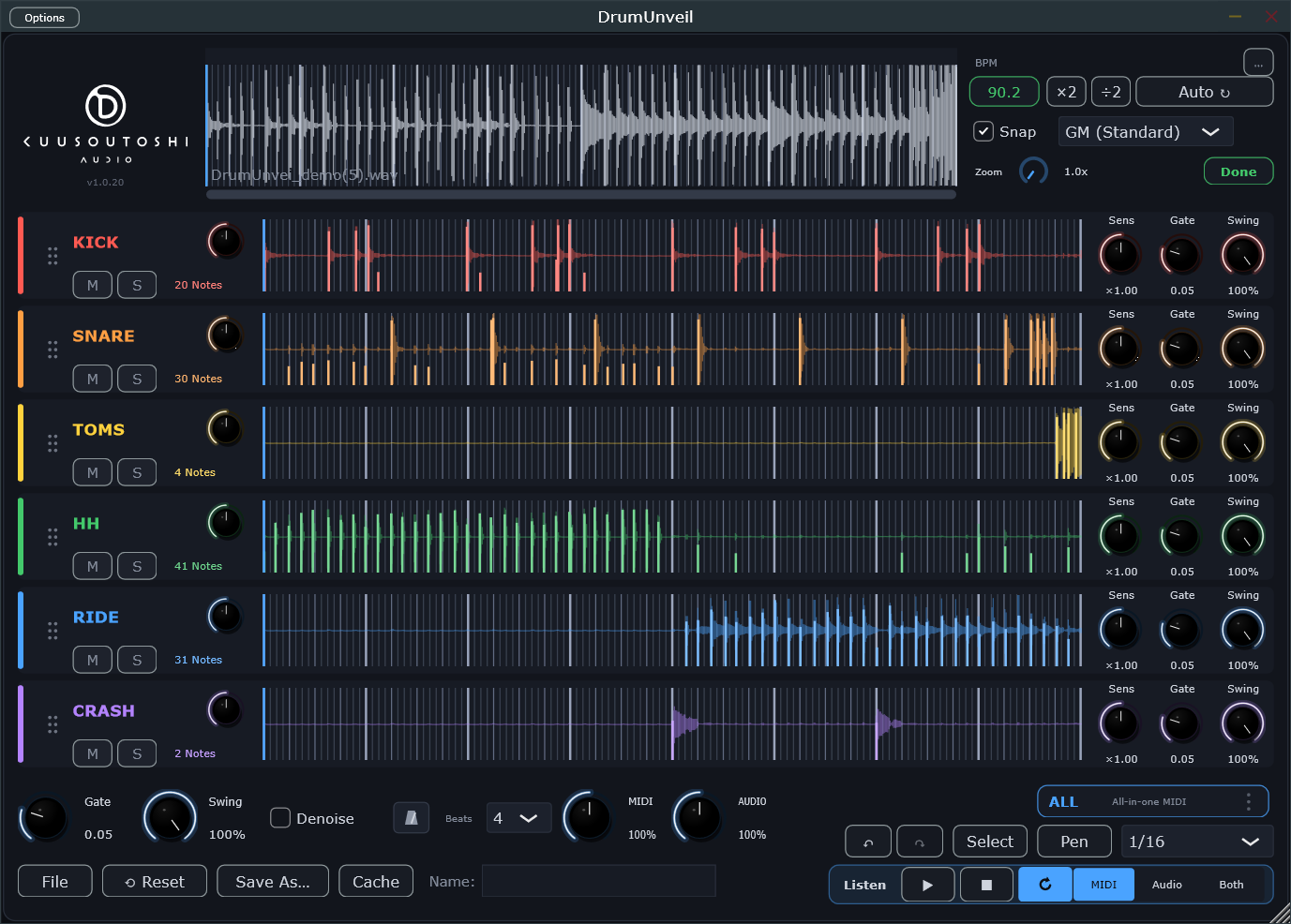
From a stereo drum mix: kick / snare / toms / hi-hat / ride / crash.

Separation and detection both run entirely on your own machine. Nothing is uploaded anywhere.

The six parts appear as six independent waveforms, so you can see which piece of the kit is playing where.

KICKLANE 1
SNARELANE 2
TOMSLANE 3
HI-HATLANE 4
RIDELANE 5
CRASHLANE 6
Six separated lanes
Straight after analysis — six parts, six separate waveforms.

▸ Separation and detection both run on the CPU.

Decide what counts as a hit.

"Catch every hi-hat, but ignore what's left over in the crash lane." That's a per-lane control, not a global one.

Sensitivity
How hard a hit has to be before it counts. One knob per lane.
Whether soft ghost notes and feathered kicks make it through is your call, not the algorithm's.
Floor (gate)
A cutoff relative to the loudest hit in the whole file. It stops the faint bleed left behind by separation from being counted as a real note.

One knob, and the bleed is gone.

Example: raising the Gate on the snare lane only, from 0.05 to 0.20 — 30 notes become 12.

BEFORE · GATE 0.05Snare lane, Gate 0.05
AFTER · GATE 0.20Snare lane, Gate 0.20
Raise the Gate on one lane, and only that lane's real hits remain.

How much of the feel do you keep?

Detected notes are pulled toward the grid by a continuous 0–100% control.

Applies at
PER REGIONPER LANEGLOBALLY

"Tighten the second verse only." "Line up the hats, leave the rest." Those are single moves here.

▸ Which makes DrumUnveil a rhythm repair tool as well: a sloppy loop in, a tight MIDI part out.

Same take, dead on the grid.

Example: the hi-hat lane only, Swing from 100% to 0% (zoomed in on one bar).

BEFORE · SWING 100%Hi-hat lane, Swing 100%
AFTER · SWING 0%Hi-hat lane, Swing 0%
Each hit snaps from its original attack point to the nearest grid line.

Mapped to your drum instrument.

The MIDI note numbers are converted to match whatever you're playing back with.

GM (general layout) Addictive Drums 2 Toontrack (EZdrummer / Superior Drummer) Your own mapping

Pick your instrument and every part of the kit is mapped to its note numbers automatically. If yours isn't listed, build your own mapping, save it under a name and recall it any time.

▸ the last mapping you used is remembered, so you don't pick it again every session.

Three ways to get it out.

All at once
Six parts of audio plus the MIDI in a single drag. Files are numbered, so they land in the DAW in kit order, 01_kick first.
One at a time
Grab a single lane and drag just that.
Mixed
Kick as MIDI, hi-hat as raw audio, snare as both. Choose per track on a small mixer and pull the whole thing out in one drag.

Exported audio carries its tempo embedded, so your DAW won't guess wrong and scatter the parts across different tempos.

MIDI or audio, lane by lane.

In Both mode, each lane plays MIDI, the separated audio, or both — each with its own pan. Pan the MIDI right and the audio left, and you can hear whether the notes sit on the original hits while you work.

MIXER · BOTH MODEPer-lane MIDI/audio switches and pan
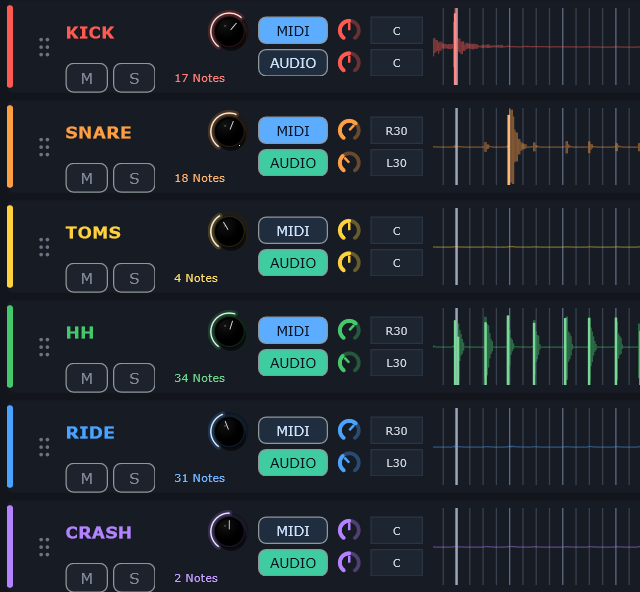
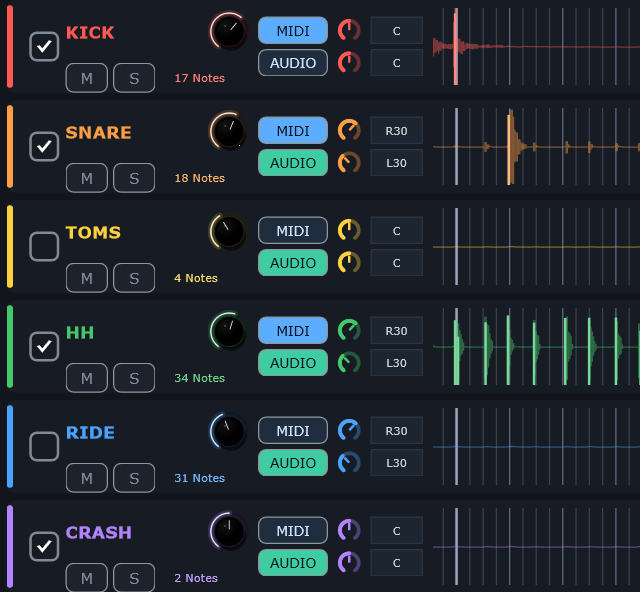
SELECT · CHECKED LANESSelect mode with lanes checked
Turn on Select, check the lanes you want, then drag from the name of any checked lane — all the checked lanes go out together.

Fix it before it leaves.

Snare lane, notes placed with the pen
Notes placed on the grid with the pen — hand-placed notes are outlined in white.

Hear it before you commit.

The details.

FormatsVST3 / AU / Standalone
WindowsWindows 10 (1809) or later · x64 (Arm-based Windows not supported) — VST3 / Standalone
Disk spaceAbout 1 GB (the separation model is about 420 MB)
macOSmacOS 11 or later · Apple Silicon — VST3 / AU / Standalone
ProcessingFully local — no audio is uploaded
LicenceOne-time purchase · 2 machines per licence

▸ Note: DrumUnveil is not an ARA plugin. You drop loops onto the plugin window rather than having it analyse the DAW timeline directly.

Get the full version.

$49
LAUNCH PRICE
Goes to $69 when the launch period ends
One-time · no subscription · 2 machines per licence
Prices in USD, excluding tax. Any sales tax or VAT for your country is added at checkout.
BUY DRUMUNVEIL — $49

Not sure? Try it before you buy — it's the same app, it exports kick and snare MIDI, and it has no deadline.

▸ Two machines, what happens after you buy, internet → Licence details

One licence. Everything exports.

What a licence unlocks

With a licence, you can export the separated audio and the MIDI for all six lanes.

Without one, you can export kick and snare MIDI with no time limit. Separation, detection, sensitivity, swing, region editing, note editing and audition work the same either way — so you can check it on your own material before you pay.

Two machines

One licence covers two computers. To move to another computer, open File → License… on the current one and press Deactivate this machine, then enter the key on the new computer.

After you buy

If DrumUnveil is already installed, there's nothing new to download. If you haven't installed it yet, get the installer from the download page first. Your licence key arrives in the receipt email and is also available under My Orders on Lemon Squeezy. Open DrumUnveil, choose File → License…, paste the key and press ACTIVATE.

Internet connection

Not needed for analysis; everything runs locally. Only licence activation needs a connection. After that, a short re-check runs at startup and about once a day — if it can't reach the server, DrumUnveil keeps working for 30 days.

▸ For the conditions of purchase and use, see the Terms of Use and Refund Policy.

Frequently asked questions.

What material works best?+
Live drum performances, lo-fi processed loops and programmed beats are all well within range. Tracks with risers, impacts and other effects layered in still come through with the underlying beat intact.
What doesn't work well?+
Unusual timbres — pitched snares in particular, common in AI-generated material — can blur the line between snare and hi-hat during separation. Mic'd live playing can also blur the line between ride and hi-hat, so cymbal hits may land in the neighbouring lane. Even then, the sensitivity controls recover most of it. Try it on your own material before you buy.
Can it separate in real time?+
No. You drop a file in and wait for the analysis. It does not split your DAW's output as it plays.
Is it an ARA plugin?+
No. It doesn't read the DAW timeline — you drop loops onto the plugin window instead.
What can I do before I buy?+
You can try separation, detection, adjustment, editing and audition with no time limit — and export kick and snare MIDI too. See Licence for details.
Can it handle full-length tracks?+
Yes, it just takes longer — roughly six minutes for a three-minute track. Loops take tens of seconds.
Does it need an internet connection?+
Not for analysis. Only licence activation needs a connection. See Licence for details.
Will the audition playback fight with my DAW?+
Audition has its own play button and runs independently of the DAW transport, so it will keep sounding if you start the DAW while it is playing. Stop audition first, or simply work with the plugin window open while the transport is stopped.
One caveat: audition rides on the DAW's audio processing, so it will not run on a track with no audio flowing through it (observed in GarageBand). Use a software-instrument track, or place one audio region on the track. The standalone application has no such limitation.
SUPPORT · DOWNLOAD · 日本語